

.svg)

Capturing the Japanese Landscape in Tokyo's Gardens
I spent several months in Japan, but I didn’t climb to the summit of Mount Fuji. I didn’t walk along the terraced rice fields or watch the waves crash against the northern coast. I first discovered my own Japanese landscape in the gardens of Kyoto and Tokyo, and it took me some time to realize that what I was seeing were genuine landscapes—perhaps in the most authentic form this country could offer me. For a Japanese garden is a landscape in miniature: an entire world composed, framed, and distilled to fit within the gaze of those who sit down and take the time to appreciate it.
My Discovery of Gardens in Japan
My first encounters with Japanese gardens took place in Kyoto, during a week in early December when the sun never stopped shining. The trees were still adorned with their red and yellow leaves—a lingering autumn that seemed to have waited just for me—and I wandered from one temple to the next, marveling at the discovery of this country, which I was seeing and experiencing for the very first time.
What I found was a sense of clarity. Precision everywhere: the ground swept clean down to the last pebble; the trees pruned not to constrain them but to strip away everything superfluous, leaving only the essence of their form. There was also a balance between the mineral quality of the rocks, the organic quality of the mosses, and the water, which remained crystal-clear. And above all, there was this connection to the spiritual, for these gardens are most often nestled within temples, as if beauty and contemplation could not be conceived of separately.
These places exude something we can’t quite put into words—something we feel before we understand it: a harmony, a peace, a calm, a serenity that settles within us the longer we stay. These gardens are a subtle reflection of Buddhist meditation, where the only thing that matters is letting go and connecting with an inner state that thoughts cannot grasp—a state that forms the foundation of our existence.
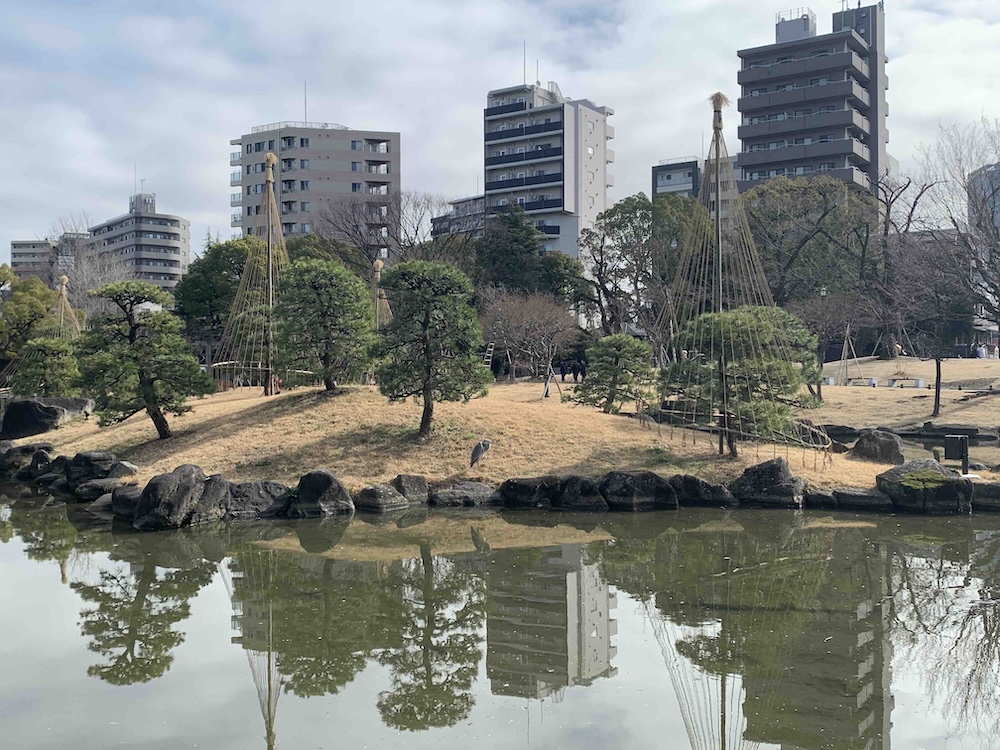
I came across this in Tokyo, which surprised me at first. In these artfully designed parks, surrounded by steel-and-glass skyscrapers, the energy of Kyoto’s gardens remained intact. All you have to do is sit for a moment, let the city fade into the background, and you’ll feel that vibration again—one so unique to Japan.
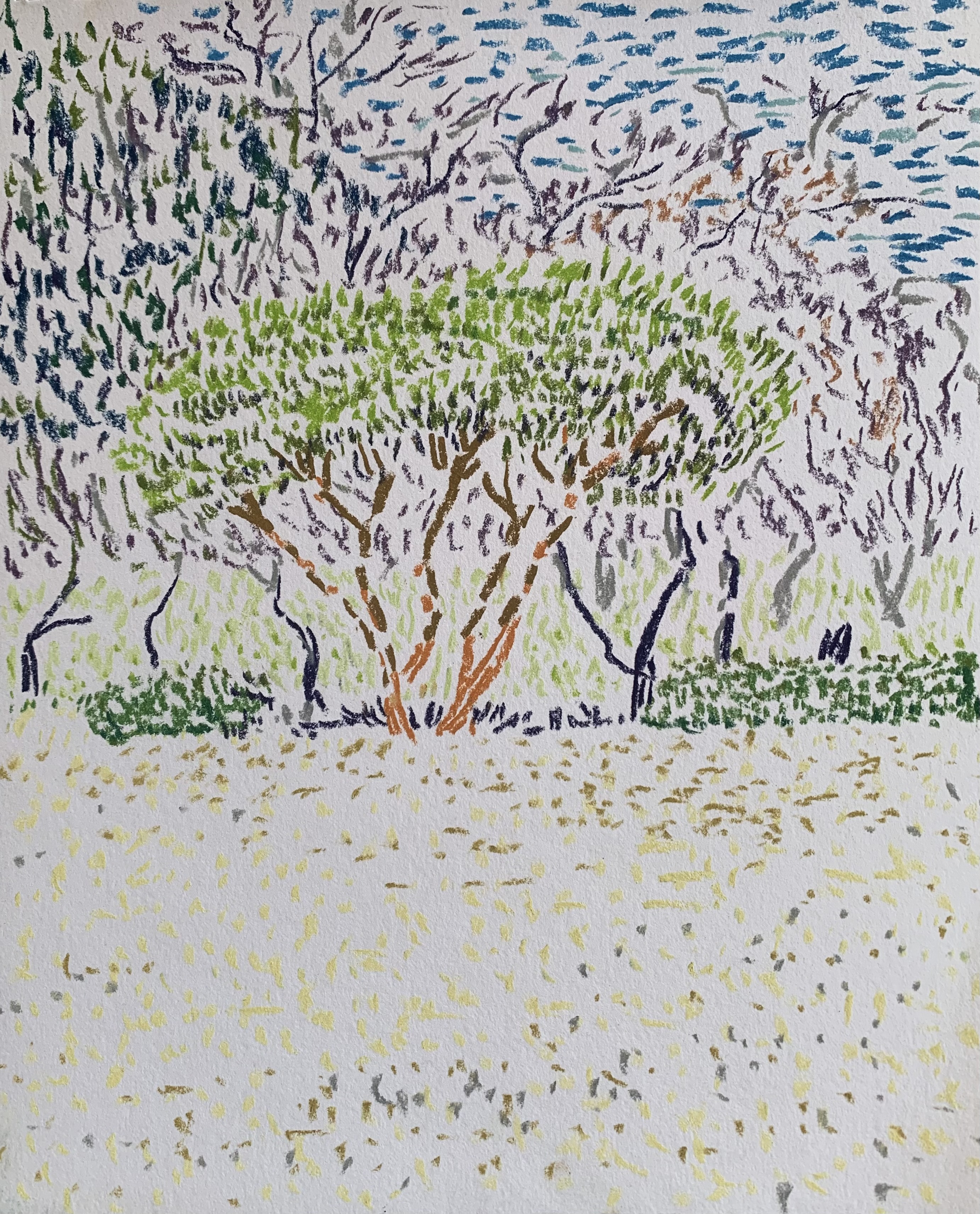
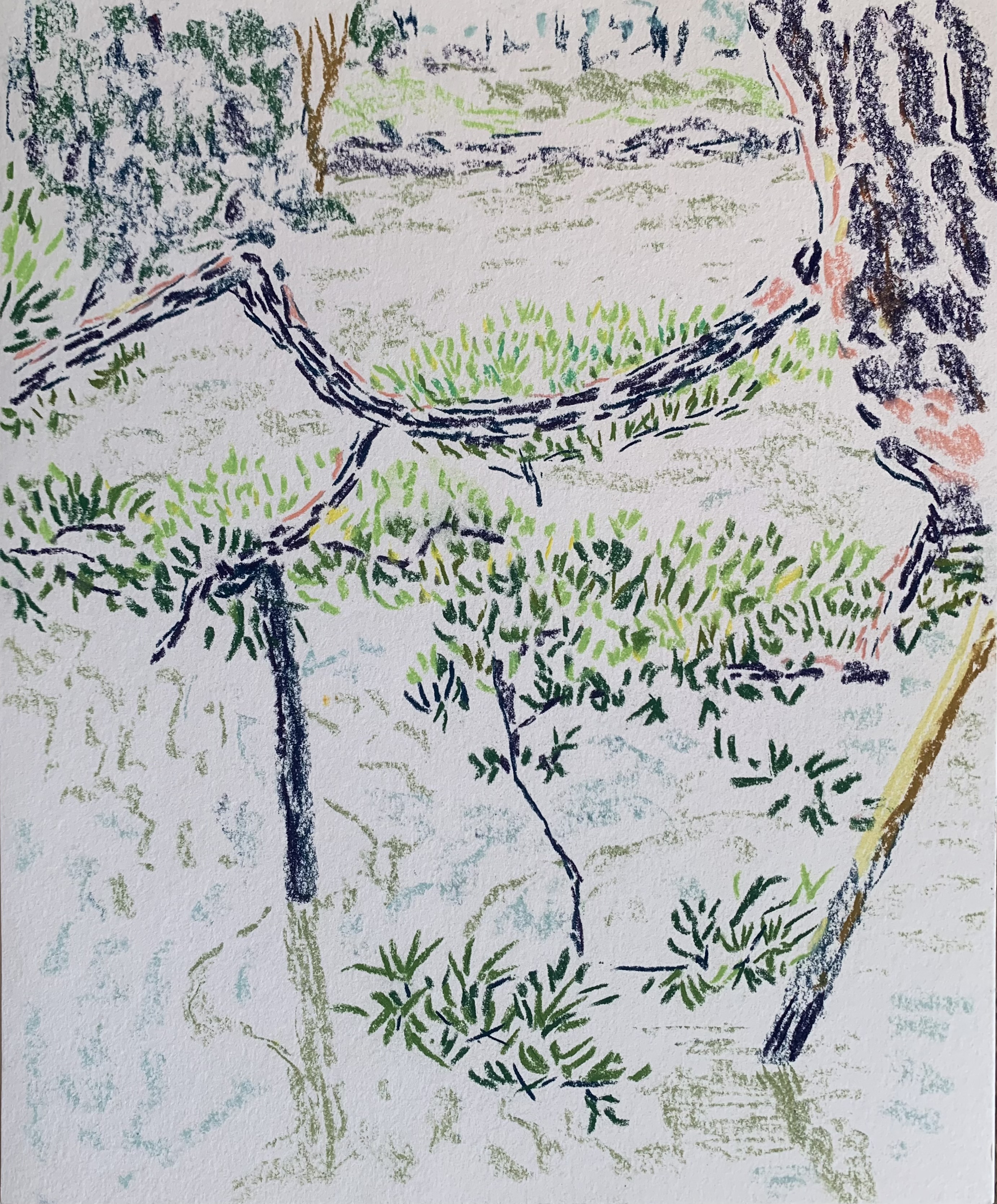
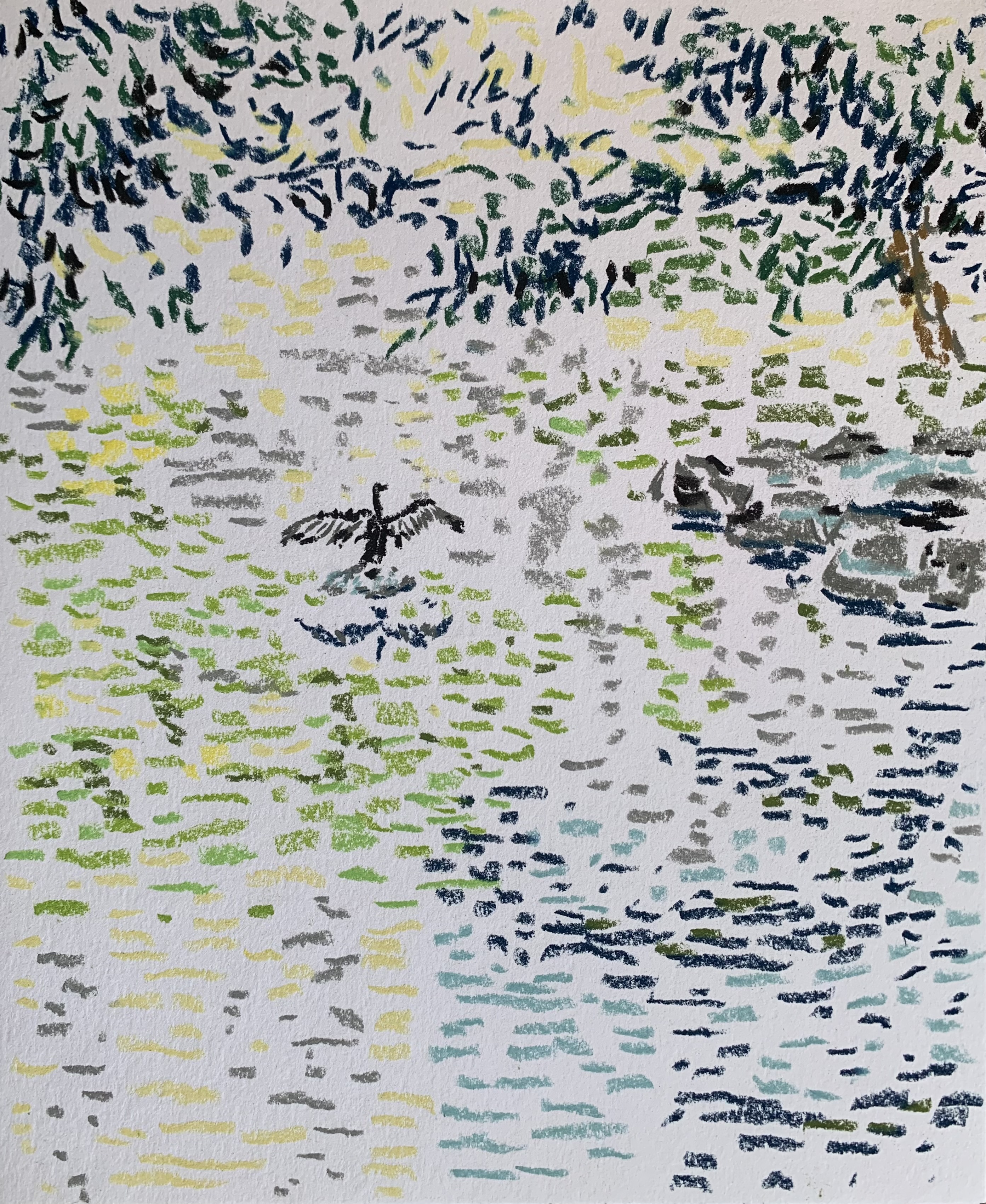
And that’s when I began drawing them, using a new pastel technique I’d picked up upon my return from Japan to the Perche region of France. It’s precisely this energy that I love to capture in pastel, with the vibrant strokes that the medium allows: the pine trees in Kokyo Gaien Park, those in Sumida Park, and the stone lantern bathed in the light of Shinjuku Gyoen.
A landscape from a distant place
These gardens, which we tend to think of as purely Japanese, actually have deeper roots. It was in China that the shanshui balance emerged—this harmony between the mineral and the vegetal, between mountains and water. In fact, I first experienced this in Hong Kong: through the contemporary artists at the M+ Museum, but also thanks to the small garden on Hollywood Road, at the foot of the building where I lived, where Chinese people would gather in the morning to practice their slow qi gong exercises.
But it was in Japan that these gardens truly transported me. Here, there seems to be a more continuous connection between nature and the garden. Elsewhere, the garden is a composition of plants or seeks to imitate the landscape, presenting a fragment or an image of it; in Japan, it seems as though the landscape is contained within the garden, that it truly dwells there rather than being merely reproduced. The difference is subtle, and it changes everything.
This can undoubtedly be explained by Shinto, that ancient, animist religion in which thousands of gods dwell—some in a rock, some in a tree, a mountain, or an animal. This is the source of the Japanese people’s deep connection to nature: they do not see themselves as standing above it; rather, they feel they are part of it, one element among many. This is a far cry from the Western perspective, which looks down on the landscape and dominates it as if it were territory to be conquered. Here, one does not look down; one belongs.
Pastel for Capturing Landscapes
Perhaps that is why pastel seems to me to be so well-suited for painting Japanese landscape gardens. Beneath its broken lines, the subject dissolves. What remains are not solid, defined forms, but fleeting presences—energies that flow and do not settle. One cannot truly grasp anything, cannot hold on to anything: what one takes in with one’s gaze has already vanished the moment one looks at it.
That is exactly what these gardens have taught me, and what I strive, stroke by stroke, to capture on paper: not a place, but that fleeting moment when a garden ceases to be a place and becomes an emotion. To capture the existence that lies between fullness and emptiness, between fleeting water and enduring rock, between the pine tree growing, shaped by pruning, and the moment suspended like pastel strokes—each carrying a fleeting instant and ultimately coming together to form a whole.
I didn’t climb Mount Fuji. I gazed at gardens for a long time, and there I felt the very soul of a country that masters like Hokusai were able to share through their ukiyo-e—prints made from carved woodblocks. And sometimes I feel as though my light strokes of pastel on paper are like the marks of a chisel on wood—strokes whose rhythm echoes the tradition of those master engravers. They mark the passage of time in these gardens where time seems to stand still, much like in the karesansui—rock gardens where everything is frozen in place, as if to ask us where time has gone when nothing moves anymore. These mineral-like Zen gardens evoke more than just seascapes and mountain landscapes; they pose, as in a kōan, the enigma of time.

_-_left_hand_screen.jpeg)